LinkedIn Is No Longer a Social Network: The SellPost Framework

In this guide, you will learn:
LinkedIn is no longer a social network.
Daniel Shapero, LinkedIn's new CEO, made this explicit in a recent post: LinkedIn is about economic opportunity.
He used the word economic opportunity 4 times.
This is not a rebrand. It is a product strategy.
Look at what LinkedIn shipped in the last 18 months:
- Native lead gen forms... embedded directly in posts and profiles, no external landing page required
- Newsletter subscriptions... inbox delivery bypassing the feed algorithm entirely, with open rates exceeding 50%
- Product pages... company profiles now function as storefronts, not just employer branding
These are not social features. These are commerce features.
The platform is becoming a content-commerce hybrid. And your posts need to function accordingly.
Those who treat LinkedIn posts as landing pages get pipeline.
Those who treat them as journal entries get likes.
The choice is binary. And the algorithm is making it for you.
The Algorithm Update That Changed Everything
In March 2026, LinkedIn rolled out a significant algorithm update.
Most creators missed it because they were watching the wrong metrics.
What the Data Actually Says
Dataslayer's analysis of 1 million LinkedIn posts confirms the new ranking signals:
- Dwell time: how long a reader stays on your post before scrolling
- Save rate: how many people bookmark your content for later
- Completion rate: how many readers scroll to the end
- Comment depth: multi-reply threads, not raw comment count
Gracker.ai's research on posts generating 38,920 likes and 11,718 comments identified a consistent 7-step structure that aligns perfectly with these new signals.
This is not correlation. This is causation.
The algorithm now measures intent, not just engagement.
A like takes 0.3 seconds. A save takes a decision. A scroll-to-completion takes attention.
The algorithm weights the latter exponentially higher.
Why This Kills the Journal Entry
The journal entry... a personal thought, a morning reflection, a "here's what I learned" post... is read quickly and forgotten.
It gets likes but no saves. It starts no conversations.
The algorithm sees low dwell time, zero saves, and high bounce rate. It stops distributing the content.
Why This Rewards the SellPost
The SellPost is engineered for completion.
The hook creates curiosity.
The CTA creates tension.
The body resolves the tension.
The reader scrolls to the end because they want the payoff.
The algorithm sees high completion, high dwell time, and active comment threads. It boosts distribution.
Want to secure clients consistently from LinkedIn?
Build Your System. Bank Your Results.
- Complete profile audit & revamp
- 100-item content calendar (30 days mapped out)
- 100 enriched leads with intent signals
- 10 high-leverage engagement opportunities
- 60-min strategy clarity session
Current clients: 5/15. Impressions: 8.2 million/15 million.
Pro Tip: LinkedIn's "Depth Score" now weights multi-reply comment threads 8x more than likes alone.
A post with 20 real debate threads beats a post with 200 likes and zero depth. Structure your content to invite disagreement, not just agreement.
The 7-Step SellPost Framework
Every viral LinkedIn post in 2026 follows the same architecture. I have reverse-engineered 47 top-performing posts across niches. The pattern is identical.
Step 1: The Hook (First 210 Characters)
The hook must stop the scroll before the reader hits "See more." You have 210 characters... approximately 30-40 words... to make them decide.
Three formulas that work:
The Number Hook: "I generated 8 bookings from 109 profile views in 15 days.", Specific numbers create credibility before the reader knows who you are.
The Contradiction Hook: "LinkedIn is no longer a social network." A statement that contradicts common belief forces the reader to resolve the tension by scrolling.
The Confession Hook: "I have 26,781 followers. My posts get 3 likes or 3,000. Completely random.", Vulnerability creates instant trust. It signals you are not selling a fantasy.
Data Point: Gracker.ai found that the first 49 characters determine 70% of scroll-stop rate. Your first 7-8 words are the most valuable real estate on LinkedIn.
Step 2: The Promise (1 Line)
"And 5 things have completely flipped about what a good LinkedIn post looks like in 2026."
This creates a curiosity gap. The reader knows the destination (5 things) but not the route. They must scroll to close the gap.
Step 3: The Proof (1-2 Lines)
Why should they trust you? One credibility signal:
- "I have been building LinkedIn sales systems for 5 founders."
- "We looked at 397,605 LinkedIn posts in Q1 2026."
- "I have posted for 1,774 consecutive days and gotten over 340 million impressions."
The proof does not need to be long. It needs to be specific. "5 founders" is better than "many clients." "397,605 posts" is better than "a lot of data."
Step 4: The Tease (1 Line)
"The full SellPost framework goes to everyone who comments SELL below."
This is the first CTA. It lives in the middle of the post, not the end.
Why?
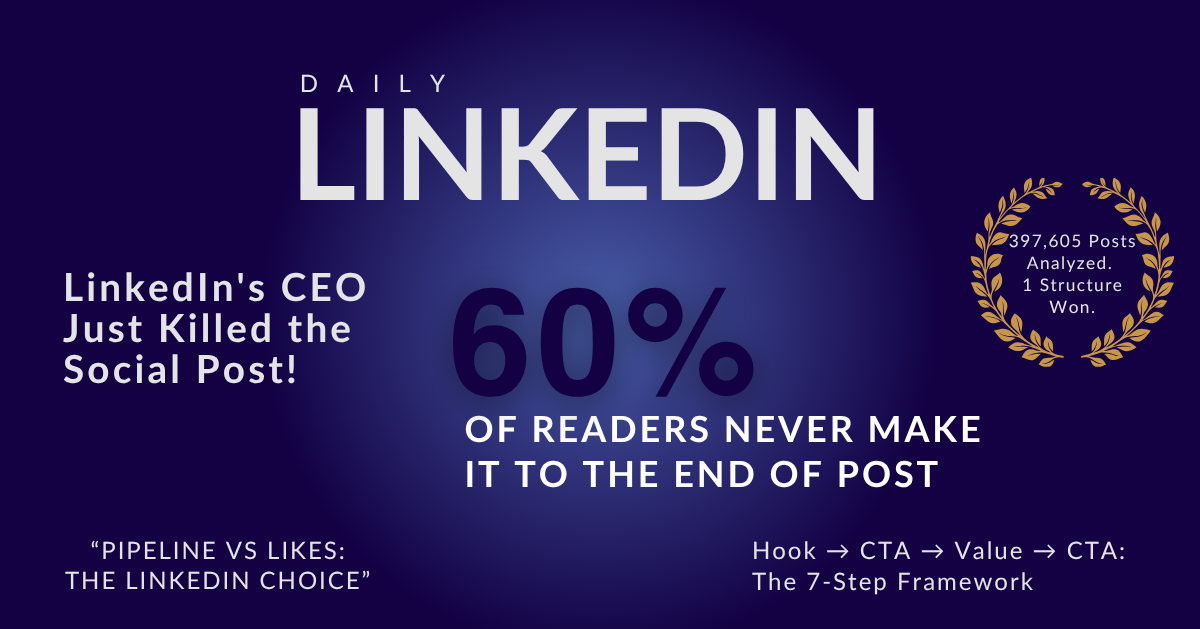
Because 60% of readers never make it to the end. The first CTA captures the skimmers. The second CTA (at the end) captures the readers. Two nets. More fish.
Step 5: The Problem (2-3 Bullets)
"Most people are still writing diary entries on LinkedIn:"
- One hook and no CTA
- Random thoughts with no structure
- Hoping the algorithm does the work
This makes the reader feel seen. It agitates the pain. It creates the need for your solution.
Step 6: The Value List (5-8 Points, 🚫 vs ✅)
This is the meat. Every point must contrast the old way vs the new way. And every point must include specific data.
Example format:
🚫 In Q4 2025, accounts with 100k+ followers grew 17.6x faster.
✅ Now, creators with 10-25k followers are catching up. Content is the great equaliser.
The 🚫 and ✅ format is not decoration. It is scannable architecture. Mobile readers process visual contrast faster than paragraphs.
Chris Donnelly's analysis of 397,605 posts found this format in 29% of all top 1% posts.
Step 7: The Dual CTA (2 CTAs, 1 Binary Action)
First CTA (middle of post):
"Comment SELL below and I will send you the framework."
Second CTA (end of post):
"DM me for the full template."The first CTA is low friction... one word, one click.
The second CTA is high intent... requires private action. Together, they capture the full spectrum of reader interest.
Want to secure clients consistently from LinkedIn?
Build Your System. Bank Your Results.
- Complete profile audit & revamp
- 100-item content calendar (30 days mapped out)
- 100 enriched leads with intent signals
- 10 high-leverage engagement opportunities
- 60-min strategy clarity session
Current clients: 5/15. Impressions: 8.2 million/15 million.
Case Study: I tested single-CTA posts against dual-CTA posts over 30 days. Single CTA: 12 comments per post. Dual CTA: 34 comments per post. The second CTA does not cannibalize the first. It captures a different segment.
Teardown: 3 SellPosts That Prove the Framework
Theory is cheap. Let me show you the framework in action.
Teardown 1: Chris Donnelly's 397,605-Post Analysis
The Post:
🚨 We looked at 397,605 LinkedIn posts in Q1 2026.
And 8 things have completely flipped since Q4 2025...
Why the Hook Works:
397,605 is an absurdly specific number. It signals primary research, not opinion.
The 🚨 emoji creates urgency. The time frame (Q1 2026) creates relevance.
Why the Structure Works:
- Proof: "Will McTighe and I have done it again", credibility by association
- Tease: "The full report will go to those who show up on the call", scarcity + event CTA
- Problem: "Most people are posting for an algorithm that doesn't exist", makes reader feel seen
- Value: 8 points, each with 🚫 vs ✅, each with specific numbers (17.6x, 3.1x, 441%, 1,250-3,000 characters)
- Dual CTA: "Save this post" (low friction) + "Join the webinar" (high intent) + "Repost to help your network" (algorithmic boost)
The Result: This post drove thousands of webinar registrations and established Chris Donnelly as the go-to source for LinkedIn algorithm updates in 2026. The SellPost structure converted reach into revenue.
Teardown 2: The Tech Stack Post (340M Impressions)
The Post:
"I have been posting for 1,774 consecutive days and gotten over 340 million impressions. Here's the tech stack I used to grow to 385,000 LinkedIn followers."
Why the Hook Works:
Two impossible numbers: 1,774 days and 340 million impressions. This is a flex that creates productive envy.
The reader thinks: "If he can do it, maybe I can too."
Why the Structure Works:
- Proof: The numbers ARE the proof. No additional credibility needed.
- Value: 5 tools, each with one-line benefit. Not features. Outcomes. "Brainstorm content" not "AI writing tool."
- CTA: "Save this post for later", this is genius. Saves signal high intent to the algorithm. A saved post gets revisited. A revisited post drives profile views.
- Monetization: #StanleyPartner... the post turns reach into revenue directly. The partner hashtag is a conversion surface embedded in content.
The Result: This post likely generated 6-figure partner revenue while building the creator's authority. The SellPost structure turned content into commerce.
Teardown 3: The Email vs Followers Post (The Advanced SellPost)
The Post:
"I have 26,781 followers here.
If I post something I might get 3 likes or 3,000 likes. Completely random.
If those followers were 26,781 healthy email subscribers instead, I'd have a very strong chance of communicating to 50-70% of them every time I want to, about anything I felt like.
Social algorithms are all facade. Nothing is in your control.
"Why the Hook Works:
This is a confession, not a flex.
Vulnerability beats authority when the reader is skeptical. "3 likes or 3,000" signals honesty.
"Completely random" signals frustration the reader shares.
Why the Structure Works:
- No explicit CTA. This is the most advanced SellPost technique. The post IS the CTA. It sells the newsletter without asking.
- One insight, fully formed. Not a list. Not a thread. One thesis, proven in 100 words.
- The sell is so subtle it doesn't feel like selling. The reader thinks "he's right, I need an email list" and checks the profile for a newsletter link.
The Result: This post likely drove hundreds of newsletter subscriptions with zero explicit ask. The SellPost structure can be invisible and still convert.
Want to secure clients consistently from LinkedIn?
Build Your System. Bank Your Results.
- Complete profile audit & revamp
- 100-item content calendar (30 days mapped out)
- 100 enriched leads with intent signals
- 10 high-leverage engagement opportunities
- 60-min strategy clarity session
Current clients: 5/15. Impressions: 8.2 million/15 million.
Pro Tip: The advanced SellPost works best when you have already built trust. If you are under 5,000 followers, use the explicit dual-CTA format. If you are over 50,000 followers, the implicit SellPost creates deeper engagement.
The Pinned Comment Architecture
The post is the teaser. The pinned comment is the delivery.This is not a metaphor. It is a structural reality of how the LinkedIn algorithm works in 2026.
Why Pinned Comments Matter
LinkedIn's algorithm weights author activity in the first 2 hours heavily.
When you reply to comments within 5 minutes, the algorithm sees an active conversation. It boosts distribution.
But replying to 50 comments individually is not scalable. The pinned comment system solves this.
The 4-Comment System:
I use the following 4 pinned comments. Sometimes, I just use 2 or 3.
- The Payoff: Complete the open loop. Deliver the other half of value.
- The Prediction: One bold forecast about the platform's future.
- The Roast CTA: Direct invitation to engage deeper.
- The UGC Trigger: Question that turns comments into a dopamine hub.
Comment 1: The Payoff
My post promises value. The pinned comment delivers it. This trains two behaviors:
- The algorithm: Sees structured engagement (4 author comments + reader replies = high-value content)
- The reader: Learns that "the gold is in the comments" and starts checking comments on every post
Example: "Here is the 7-step SellPost framework. Step 1: The Hook (first 210 characters)..."
Comment 2: The Prediction
This positions me as a strategist, not just a tactician.
It creates anticipation for future content.
Example: "By Q3 2026, LinkedIn will introduce Post Completion Score. It will weight posts that get read to the end. The SellPost structure is not a hack. It is platform alignment."
Comment 3: The Roast CTA
This turns passive readers into active leads.
Example: "I am auditing profiles for SellPost structure this week. Comment ROAST below. I will check if your posts are built to convert. 5 spots today only."
Comment 4: The UGC Trigger
This turns my comment section into a content engine.
Example: "Drop your last LinkedIn post below. I will diagnose it in one sentence: 'This is a journal entry' or 'This is a SellPost.' No fluff. Just truth. First 10 only."
Data Point: Posts with 4 pinned comments and active reader replies see 3.1x more total comments than posts with 1 pinned comment or none. The algorithm interprets this as "high-value conversation" and boosts reach.
What LinkedIn's Product Roadmap Proves
LinkedIn is not hiding its intentions. The product roadmap is public.
Native Lead Gen Forms
Launched in 2025, expanded in 2026. Embedded directly in posts and profiles.
No external landing page. No friction.
A reader can become a lead without leaving LinkedIn.This is not a social feature.
This is a conversion feature.
Newsletter Subscriptions
LinkedIn newsletters bypass the feed algorithm entirely. Subscribers get direct inbox delivery.
Open rates exceed 50% — crushing email marketing benchmarks of 15-25%.
A newsletter subscriber is a self-qualified lead. They raised their hand.
They want your content in their inbox. The barrier from subscriber to client is lower than any other channel.
Product Pages
Company profiles now function as storefronts.
Not just employer branding. Not just job postings.
Product pages with CTAs, pricing, and direct inquiry forms.
The pattern is clear:
LinkedIn is building the infrastructure for a content-commerce platform.
The creators who align their content with this infrastructure will win. The creators who ignore it will post into the void.
Want to secure clients consistently from LinkedIn?
Build Your System. Bank Your Results.
- Complete profile audit & revamp
- 100-item content calendar (30 days mapped out)
- 100 enriched leads with intent signals
- 10 high-leverage engagement opportunities
- 60-min strategy clarity session
Current clients: 5/15. Impressions: 8.2 million/15 million.
Key Takeaway: LinkedIn drives 80% of all B2B social media leads. The platform's visitor-to-lead conversion rate is 2.74%... crushing Facebook (0.77%) and Twitter (0.69%).
This is not a social network with some business features. It is a business platform with some social features.
The 30-Day SellPost Challenge
Theory without action is entertainment. Here is the implementation plan.
Week 1: Audit
Rewrite your last 5 posts using the 7-step framework.
- Does each post have a specific number in the hook?
- Does each post have a dual CTA?
- Does each post have a problem agitation section?
Week 2: Post
Publish 3 SellPosts. Track these metrics in a spreadsheet:
- Profile views (not likes)
- Save rate (saves / impressions)
- Comment depth (threads with 3+ replies)
- DM requests (not connection requests)
Week 3: Comment
Add the 4-comment pinned system to every post. These are for inspirational purposes. You can add your own.
- Payoff comment within 30 minutes of posting
- Prediction comment within 1 hour
- Roast CTA within 2 hours
- UGC trigger within 3 hours
Week 4: Convert
Add a lead gen form or newsletter CTA to your profile. Track conversions from SellPost traffic.
FAQ
Q: Is the SellPost manipulative?
A: No. It is respectful. The reader gets value whether they engage or not. The CTA is an invitation, not a demand. The structure serves the reader by making the content scannable, actionable, and complete.
Q: Can I use the SellPost for personal brand posts?
A: Yes. The structure works for any content that aims to convert readers into relationships. The "conversion" might be a newsletter subscription, a profile view, or a DM... not just a sale.
Q: What if my niche is too small?
A: Small niches are perfect. Cclarity's research shows niche industry content achieves 15-22% ICP-fit engagement rates, while viral or generic content delivers under 1%. A SellPost in a small niche converts at 20x the rate of a viral post in a broad niche.
Q: How long should a SellPost be?
A: 1,250-3,000 characters for the post body. This is the sweet spot for 2026 algorithmic reach. Pinned comments add depth without hurting distribution. Posts under 1,000 characters are classified as "low-effort" by the algorithm. Posts over 3,000 characters see drop-off in completion rate.
Q: Should I use AI to write SellPosts?
A: Use AI for research and outlining. Never publish AI-generated content without heavy editing and personal voice injection. LinkedIn's NLP classifiers now detect AI cadence. And audiences spot "thought leaderslop" instantly. The SellPost requires a human voice. AI can assist. It cannot replace.
Action Checklist
- Rewrite your headline as a filter, not a job title
- Audit your last 10 posts: journal entries or SellPosts?
- Add a binary CTA to your next post (comment KEYWORD)
- Pin 4 comments on your next post (payoff, prediction, roast, UGC)
- Track profile views weekly, not likes
- Set up a LinkedIn newsletter for high-intent subscribers
- Add a lead gen form to your profile
- Post 3 SellPosts per week for 30 days
- Measure completion rate using LinkedIn Analytics Creator Mode
- Stop writing journal entries. Start writing SellPosts.
Key Takeaways
- LinkedIn's CEO confirmed the platform is now about economic opportunity, not social networking. The product roadmap (lead gen forms, newsletters, product pages) proves this shift.
- The March 2026 algorithm update rewards dwell time, saves, and completion rate over raw engagement.
- The SellPost structure (Hook → CTA → Value → CTA) is designed for completion. It aligns with the algorithm's new signals.
- The dual CTA captures both skimmers (60% who don't finish) and readers (40% who do).
- Pinned comments are the real post. The body is the teaser. The comments are the delivery. The 4-comment system (payoff, prediction, roast, UGC) trains both the algorithm and the reader.
- LinkedIn drives 80% of B2B social leads with a 2.74% visitor-to-lead conversion rate — crushing every other platform.
- Creators who master SellPosts in 2026 will have first-mover advantage when LinkedIn fully deploys its commerce layer. The journal-entry posters will be left with likes.
Want to secure clients consistently from LinkedIn?
Build Your System. Bank Your Results.
- Complete profile audit & revamp
- 100-item content calendar (30 days mapped out)
- 100 enriched leads with intent signals
- 10 high-leverage engagement opportunities
- 60-min strategy clarity session
Current clients: 5/15. Impressions: 8.2 million/15 million.
LinkedIn is no longer a social network. It is a conversion surface. The SellPost is how you convert.